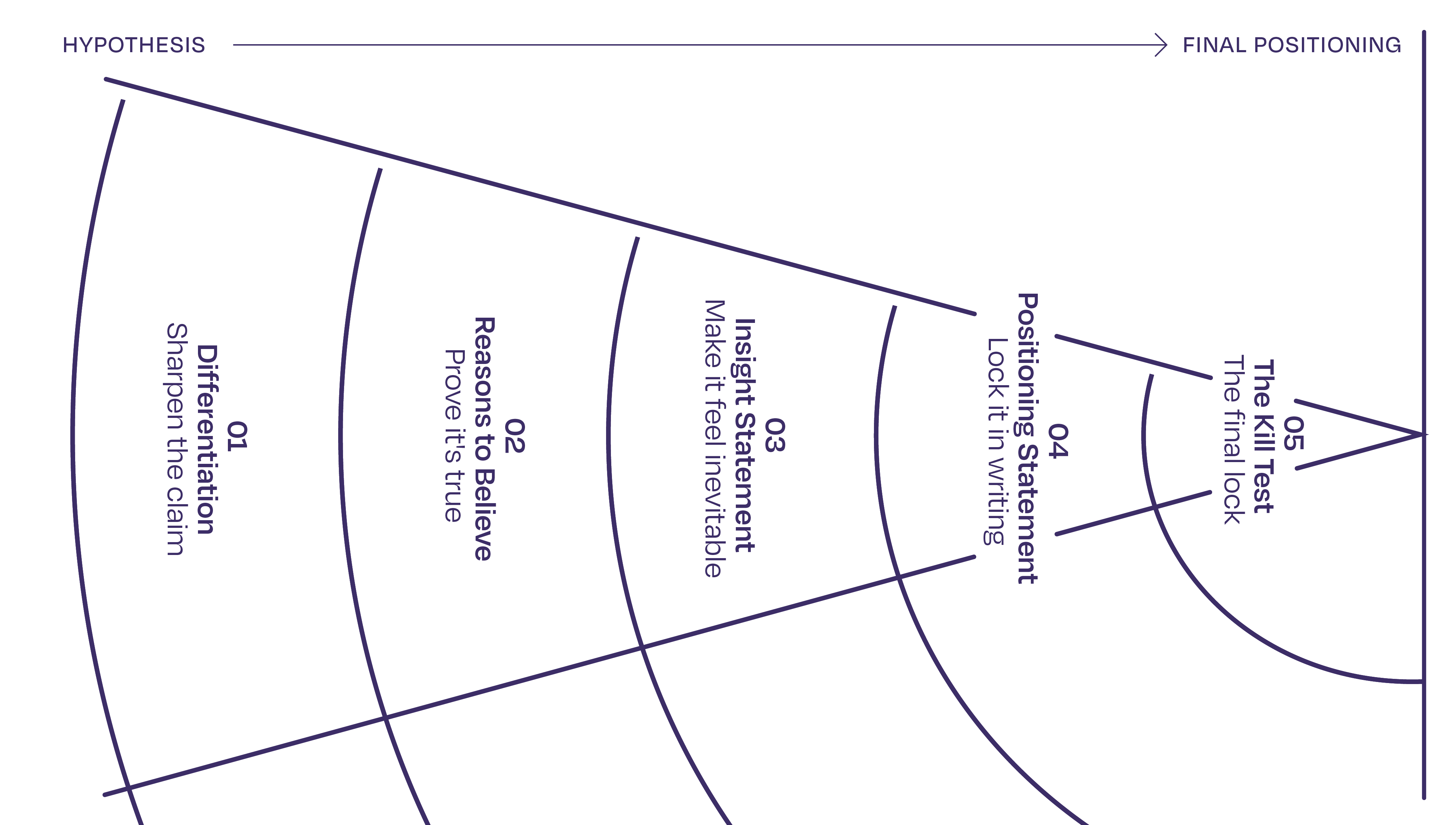
Finding your Onlyness is the start, not the finish. Most brands build on a positioning hypothesis that has never been tested. This article walks through the five steps between a raw Onlyness Statement and a verified brand position: sharpening the differentiator, building the evidence, writing the insight, locking the statement, and passing the final check. Miss any step and everything built on top of it is built on assumption.

The hardest part of building a brand isn't finding your difference.
It's proving it holds.
Most founders who've done the positioning work, arrive at something that feels true. They've mapped their strengths. They've listened to their customers. They've looked at the competitive landscape honestly. They've found the space where all three forces converge and drafted the statement.
And then they build on it. That's the mistake.
Because what they have at that point isn't a position. It's a hypothesis. And a hypothesis is something you believe. A position is something you can defend.
The gap between those two things is where most brands quietly fail, not with a collapse, but with drift. Messaging that never quite lands. Marketing that works sometimes and can't explain why when it doesn't. A brand that looks like it's performing but never quite compounds.
This article is about closing that gap.
What the Onlyness gives you, and what it doesn't
Finding your Onlyness through the 3C Differentiation Framework is genuinely hard work. Mapping the Entrepreneurial Sweet Spot, the Customer Empathy Map, the Competitor White Map — and finding the single space where all three forces converge — produces something most businesses never have: a precise articulation of what makes the brand impossible to replace.
The Onlyness Statement that comes out of that process
is still a claim.
A claim isn't a position until it has evidence behind it. Until it resonates with the customer's reality. Until it's been written in a form precise enough to build every other layer of the brand on top of.

01: Brand Differentiation.
Sharpen the claim.
The raw Onlyness Statement often contains more than one idea. Brand Differentiation compresses everything the business could stand for into the single most ownable claim — the one point of difference no competitor can replicate. If two things feel equally essential, the differentiation work isn't finished. A position with two centres has no centre.
Read the full breakdown in the Onlyness article — Step 1 is covered there in detail.

02: Reasons to Believe.
Prove it's true.
Internally
A sharpened Onlyness claim without evidence behind it is a liability dressed as an asset. Reasons to Believe force an honest audit of what the business can actually demonstrate — the track record, the specific results, the capabilities that make the differentiator credible rather than aspirational.
Internally, this step answers a question most founders avoid: is this position real, or is it where we want to be?
That distinction matters enormously before anything else gets built on top of it.
Externally
Customers don't take positions on trust. They take them on evidence — whether that evidence is explicit (results, credentials, case studies) or implicit (the confidence of the team, the precision of the language, the quality of the experience). Reasons to Believe are what make a position verifiable rather than assumed. When they're strong, the differentiator lands without explanation. When they're thin, the brand compensates with volume — more claims, louder marketing, more effort — and still doesn't convert.
The cost of getting it wrong:
Brilliant positioning with nothing behind it doesn't survive scrutiny. It fails in the sales conversation when someone asks a direct question. It fails in the pitch when a competitor has the same claim and better proof. A position built ahead of its own evidence is a vulnerability — one that gets more expensive to close the longer the brand builds on top of it.
What good looks like:
The evidence matches the claim precisely. Not adjacent to it. Not vaguely supportive of it. Directly behind it — specific enough that a sceptic would find it hard to dismiss. Each Reason to Believe connects to the Onlyness directly, not to a general sense of the business being good at what it does.
The question to ask yourself:
If a prospect challenged your positioning in the first five minutes of a meeting, what would you point to, and would it be enough?
The founder's trap:
If the Reasons to Believe are thin, that isn't a writing problem. It's a signal the Onlyness is aspirational rather than real. The instinct is to keep going — to write around the gap, to imply the proof exists, to plan to build the evidence later. Resist it. Go back to the positioning work before going any further.
Signs this step is incomplete
- The team struggles to answer direct "prove it" questions in sales conversations
- Case studies exist but don't connect directly to the positioning claim
- The differentiator is based on intent rather than demonstrated capability
- Results are strong but scattered — not anchored to the core claim
- The business has years of work behind it but the evidence feels thin when written down
- The Onlyness keeps shifting because nothing concrete is holding it in place

03: The Insight Statement.
Make it feel inevitable.
Internally:
Strategy that has to be explained repeatedly doesn't hold. The Insight Statement is the bridge between the customer's real problem and the opportunity the business is uniquely placed to solve, expressed as a single observation that makes the positioning feel obvious rather than constructed.
Internally, a strong Insight Statement means the team understands not just what the brand stands for, but why it matters. That's what allows them to communicate it naturally, without scripting.
Externally:
Most positioning sounds like strategy. The best positioning sounds like the truth was always there. The Insight Statement is what creates that feeling, the moment a prospect hears what the brand stands for and thinks: of course, why hasn't anyone done this before? It doesn't announce the differentiator. It makes the differentiator feel inevitable. That distinction is the difference between a position that has to be sold and one that sells itself.
The cost of getting it wrong:
Without a sharp Insight Statement, the positioning feels constructed. Customers can sense the effort behind it. The marketing feels like it's working too hard. The sales conversation carries the weight of making the differentiation feel relevant — rather than the insight doing that work before anyone enters the room. Positioning without insight is strategy without resonance. And strategy without resonance rarely sticks.
What good looks like:
The Insight Statement is short enough to repeat from memory. It doesn't require context before it lands. It captures something true about the customer's situation that the brand is uniquely positioned to address. When it's said aloud, people wonder why no one said it sooner.
The question to ask yourself:
Can you articulate the one truth about your customer's situation that makes your positioning feel necessary rather than optional?
The founder's trap:
Founders write insights about themselves, what the business does, how it's different, why it's better. An Insight Statement starts with the customer's reality. The business only enters the picture because of how it relates to that reality. If the insight sounds like a brand claim, it isn't sharp enough yet.
Signs this step is incomplete:
- The positioning has to be explained before it resonates, it doesn't land on its own
- Prospects understand what the brand does but not why it matters to them specifically
- The differentiator feels logical but doesn't create urgency
- Marketing generates awareness but not conviction
- The brand is respected but not sought out
- Clients come through referrals but can't clearly articulate why they recommended you

04: The Brand Positioning Statement.
Lock it in writing.
Internally:
The Brand Positioning Statement is the strategic anchor. Every layer of the brand, the emotional territory, the service experience, the verbal and visual language, the identity, every customer touchpoint, gets built on top of this single written statement. Internally, it ends debate.
When the positioning is written, precise, and agreed upon, brand decisions at every level become faster and more consistent. Teams stop interpreting the brand through personal preference and start referencing something fixed.
Externally:
The Brand Positioning Statement doesn't appear verbatim in marketing. It isn't a tagline or a headline. It's the internal document every external communication is built from. When it's right, every campaign reinforces the same idea, every piece of content pulls in the same direction, and the brand compounds, becoming more recognisable and more trusted the more it's seen.
The cost of getting it wrong:
A weak positioning statement produces weak downstream output. Messaging that drifts. Identity that feels generic. Marketing that looks like the category rather than the brand. Every layer built on an imprecise statement inherits its imprecision. Which is why the Reasons to Believe and the Insight Statement matter as much as they do — the Brand Positioning Statement is only as strong as what went into it.
What good looks like:
The statement is precise enough to build on. It contains the verified Onlyness, the evidence that supports it, and the insight that makes it resonate, in a single written form that anyone in the business can reference and anyone on the outside would feel, even if they never read it directly.
The question to ask yourself:
If you handed the Brand Positioning Statement to a designer, a copywriter, and a salesperson independently — would all three produce something that felt like the same brand?
The founder's trap:
This isn't the same as the Only-ness Statement drafted in the Onlyness process. That was the hypothesis. This is the verified version, supported by evidence, sharpened by insight, written in a form precise enough to anchor every layer of the brand built after it. Treating the hypothesis as the finished statement skips the work that makes the position real.
Signs this step is incomplete:
- The positioning exists in the founder's head but isn't written down anywhere
- Different team members would write different versions of what the brand stands for
- The statement exists but changes every few months
- Designers and copywriters interpret the brand differently every time they're briefed
- Marketing and sales are pulling from different versions of the story
- The brand has strong assets but no single statement holding them together

05: The Kill Test.
With the Reasons to Believe in place, the Insight Statement sharp, and the Brand Positioning Statement written, one test remains.
Could a competitor say the same thing? Not a worse version. Not a similar claim. The same thing, with equal credibility, equal evidence, equal conviction.
If yes, the work isn't finished. Go back. Tighten the differentiator. Strengthen the evidence. Sharpen the insight. Until what comes out the other end is a statement no competitor can absorb without becoming something different from what they are.
When it passes, cleanly, without qualification, the position is real. The Onlyness is verified. The brand has something worth building on.
Does that sound familiar?
What a verified position does for the business
A locked positioning statement isn't just a brand asset.
It's a business asset.
When the position is verified, the marketing has a centre to build around. The message has a core to express. The identity has something worth translating. Every layer of the brand performs better because what sits underneath it is real, not assumed, not aspirational, not a hypothesis that never got tested.
When it isn't, every layer built on top compensates. The marketing carries the positioning. The identity tries to convey the differentiation. The sales team fills the gap in the room. None of those things were designed to do that job. And the business pays the cost, in wasted spend, inconsistent conversion, and a brand that accumulates activity without ever compounding.
Find the Onlyness. Then prove it holds. That's the work. That's the sequence. The answer isn't a mystery. It's in your business. Let's find it
Want to run the test yourself?
The Positioning Stress-Test walks you through all five gates — with a pass/fail check at each one and a clear instruction if you fail. Download it free and stress-test your own positioning before you build another layer on top of it.
If this article made you think about your own brand, that's worth a conversation.
Book a Free Vision Clarity Session →