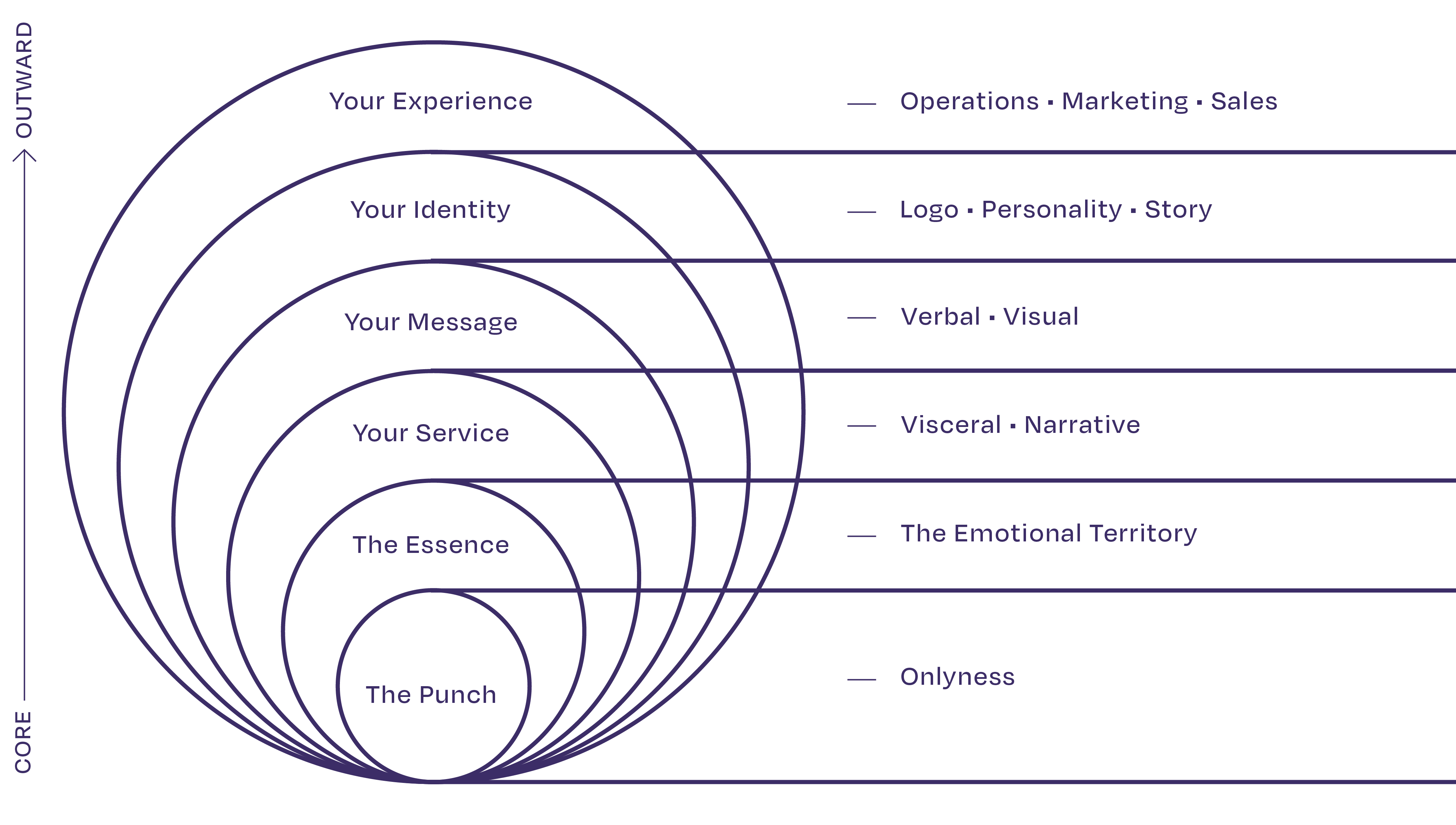
Your brand isn't broken. It's incomplete. A Brand Operating System has six layers. The Only-ness [what we call Punch] , The Essence, Your Service, Your Message, Your Identity, and Your Experience. Most businesses only ever build one, the identity, the logo, the shell. The five layers underneath it are what make it perform. This article breaks down what each layer does, what breaks without it, and the mistake founders make at every stage.

Most businesses have brand assets.
A logo. A website. Maybe a tagline. A colour palette someone chose three years ago because it felt right at the time.
What most businesses don’t have is the system underneath, the structure that holds every outer layer together and makes it perform. Without that system, the assets are just decoration. They look like a brand. They don’t work like one.
That’s what a Brand Operating System fixes.
What is a Brand Operating System?
A Brand Operating System — BOS — is the complete structure of how a brand is organised. From its strategic core to its outermost expression in the world.
It has six concentric layers. Each one builds on the one inside it. Each one only works as well as what sits beneath it.
Think of it as a series of rings radiating outward from a single point. Get the centre right and every ring around it becomes stronger. Get it wrong — or skip it — and every ring around it becomes a guess.
Most businesses build from the outside in. They start with the logo and work backwards, hoping strategy follows. It rarely does.
A Brand Operating System builds from the inside out. Strategy first. Identity last. In that order, for a reason.
Why the order matters
The instinct is to start with what’s visible. The logo is tangible. Deliverable. It gives the impression that the brand is being built.
But a logo without a core is just a mark. And a mark without meaning can’t do the job a brand is supposed to do.
When you build from the outside in, every outer layer has to carry the weight of the missing inner layers. The marketing has to explain the positioning. The logo has to convey the personality. The sales team has to articulate the differentiation. None of those things were designed to do that job.
When you build from the inside out, each layer only has to do its own work. The system carries itself.
Here’s what each layer does, and how to know if yours is broken.
Layer 1
The Punch: The verified onlyness.
Internally:
The Punch gives every person in the business a single, precise answer to the question “why us?” It ends internal debate about positioning, focus, and direction. When the core is clear, decisions at every level become faster and more consistent.
Externally:
The Punch is the one position the brand can claim that no competitor can. It’s not a tagline — it’s the competitive advantage the entire brand is built around. When it’s right, it’s felt before it’s even articulated.
The cost of getting it wrong:
Every layer built on a weak or missing Punch is built on sand. The marketing drifts. The messaging conflicts. The sales team fills the gap with whatever works in the room. The brand never compounds — it just repeats.
What good looks like:
The Punch survives the Kill Test. A competitor cannot say the same thing. It’s true, it’s ownable, and every person in the business can articulate it without hesitation.
The question to ask yourself: If a competitor read your brand positioning out loud, could they claim it too?
If yes, you don’t have The Punch yet.
The founder’s trap:
Founders confuse a strong opinion with a verified position. They write something that sounds differentiated but has never been tested against the competition or the market. The Punch isn’t what you want to be — it’s what you can actually own.
Signs this layer is missing:
1. Your team can’t answer “why you” the same way twice
2. You win work but can’t explain why
3. You chase every opportunity that comes through the door
4. Your competitors sound exactly like you
5. Your pricing is always under pressure
6. You’ve rebranded more than once without it sticking
Layer 2
Essence: The internal compass.
Internally:
Essence is the emotional translation of The Punch. It’s what the brand feels like from the inside — the guiding principle that shapes decisions without having to revisit the strategy every time. When the team understands the Essence, they make better brand decisions independently.
Externally:
Essence is what keeps the brand coherent as channels change, team members change, and markets shift. Customers may not be able to name it — but they feel it. It’s the consistency that builds trust over time.
The cost of getting it wrong:
Without Essence, the brand fragments every time something changes. A new hire, a new campaign, a new market — and suddenly the brand feels like a different company. Consistency becomes dependent on the founder being in every room.
What good looks like:
The Essence is a single, clear idea that anyone in the business can internalise. It doesn’t need to be explained repeatedly — it becomes the lens through which brand decisions are made naturally.
The question to ask yourself: If you stepped back from the business tomorrow, would your team still make brand decisions that felt like you — or would it start to drift?
The founder’s trap:
Founders carry Essence in their head and assume it transfers by osmosis. It doesn’t. If it isn’t articulated and embedded, it lives and dies with whoever holds it — and that’s usually only one person.
Signs this layer is missing:
1. The brand feels different depending on who’s running it that day
2. You can’t take a step back without things drifting
3. New hires never quite get “the vibe” — and no one can explain it to them
4. Your brand decisions are made by gut feel, not a guiding principle
5. The brand feels consistent in your head but inconsistent in the market
6. Every campaign feels like starting from scratch
Layer 3
Service: Where the promise meets reality.
Internally:
The Service layer forces alignment between what the brand claims and what the business actually delivers. It’s where strategy becomes operational — the quality, feel, and nature of the work itself has to reflect the brand at its core.
Externally:
This is where the brand stops being strategic and starts being experiential. The client doesn’t read your positioning document — they feel it in every interaction, every deliverable, every response. Service is the brand made tangible.
The cost of getting it wrong:
A gap between the brand promise and the service reality is the fastest way to destroy trust. Customers who feel the disconnect don’t just leave — they tell others. No amount of marketing repairs what a poor service experience breaks.
What good looks like:
The experience of working with the business feels like an extension of The Punch — not accidentally, but by design. The quality, pace, communication, and delivery are all expressions of what the brand stands for.
The question to ask yourself: If a client described what it’s actually like to work with you, would it match what your brand promises on the outside?
The founder’s trap:
Founders over-invest in the promise and under-invest in the delivery. The brand gets built beautifully on the outside while the service experience remains inconsistent. The gap widens as the business grows — and becomes harder to close.
Signs this layer is missing:
1. Clients love your pitch but leave after the first project
2. Your reviews are inconsistent — great one month, average the next
3. The experience of working with you depends entirely on who they deal with
4. Your brand promises one thing and your operations deliver another
5. You over-promise in sales and under-deliver in execution
6. Referrals are rare even though the work is good
Layer 4
Message: The brand speak.
Internally:
Message gives every department a shared vocabulary — verbal and visual. It defines the words, tone, and narrative the brand uses consistently, and the visual grammar that carries meaning before a word is read. Without it, every team member speaks a slightly different version of the brand.
Externally:
Message is how The Punch and Essence communicate to the world. When it’s built on a clear core, it’s focused, consistent, and recognisable. When it isn’t, it drifts — campaign to campaign, channel to channel, person to person.
The cost of getting it wrong:
Confused prospects. A sales team that pitches differently every time. Marketing that generates interest your sales process can’t convert because the language doesn’t match. Design that looks different every six months because there’s no system holding it together.
What good looks like:
Pull any piece of brand communication — a proposal, a social post, a presentation, a website page — and it sounds and looks like the same brand. The voice is consistent. The visual language is recognisable. The message reinforces the same core idea every time.
The question to ask yourself: If you pulled your website, your last pitch deck, and your most recent social content — do they all tell the same story in the same voice?
The founder’s trap:
Founders treat message as copywriting. So they hire a copywriter and call it done. But copywriting executes the message — it doesn’t define the system. Without the architecture underneath, even great copy pulls in different directions.
Signs this layer is missing:
1. Your website, proposals, and social all sound like different companies
2. Your sales team wings every pitch in their own words
3. Marketing generates leads your sales process can’t convert
4. You’ve briefed three copywriters and none of them captured it
5. New team members don’t know how to talk about what you do
6. Your tone changes depending on who wrote the content that week
Layer 5
Identity: The face of everything built beneath it.
Internally:
Identity gives the team a complete, codified system — logo, personality, story — that removes ambiguity from brand decisions. When the system is documented and accessible, design becomes faster, more consistent, and less dependent on individual taste.
Externally:
Identity is the first signal. Before anyone reads a word, they’ve already formed an impression. But an identity built on top of a clear Punch, a defined Essence, and a consistent Message means something. An identity built in a vacuum is just a shape.
The cost of getting it wrong:
You look like everyone else. You rebrand every few years chasing relevance. You spend on design that doesn’t perform — because there’s no strategy underneath it for the design to express.
What good looks like:
Every element of the identity — logo, colour, typography, imagery, tone — is a direct expression of what sits in the four layers beneath it. The identity is distinctive, scalable, and gets stronger over time because it’s built on something real.
The question to ask yourself: If you removed your logo from your marketing, would anyone still know it was you — based on look, feel, tone, and experience alone?
The founder’s trap:
Founders start here because it feels like progress. A new logo feels like a new brand. It isn’t. It’s decoration on top of whatever was there before. The identity is the fifth thing to build — not the first.
Signs this layer is missing:
1. Your brand looks different across every platform
2. Every new campaign requires a design debate
3. You’ve changed your logo more than twice in five years
4. Clients can’t recognise your content without seeing your name
5. Your design feels dated but you don’t know what to update
6. You have brand guidelines nobody follows
Layer 6
Experience: Every touchpoint, intentionally designed.
Internally:
Experience requires the whole business — not just marketing. Operations, sales, and service all contribute to the total impression the brand makes. When every department understands their role in the brand experience, consistency stops being a marketing problem and becomes a company standard.
Externally:
Experience is memory. Customers don’t remember what you said — they remember how you made them feel. Every invoice, every pitch, every social post, every client interaction is an expression of this layer. When the five layers beneath it are solid, the experience is consistent and compelling. When they aren’t, it’s inconsistent and forgettable.
The cost of getting it wrong:
strong inner brand that falls apart at the edges. Great positioning, poor follow-through. Clients who don’t return and don’t refer — not because the product failed, but because the experience didn’t hold up.
What good looks like:
Every touchpoint — digital, physical, human — feels like the same brand. There’s no gap between the first impression and the fiftieth interaction. The experience reinforces The Punch at every point of contact, without anyone having to think about it.
The question to ask yourself: Can you map every touchpoint a customer has with your brand — from first impression to post-sale — and confidently say each one reflects what you stand for?
The founder’s trap:
Founders design the core and delegate the edges. But experience isn’t a department — it’s the sum of every decision the whole company makes. When it belongs to no one, it becomes everyone’s problem — and the brand leaks from the outside in.
Signs this layer is missing:
1. The first impression is strong but the ongoing experience disappoints
2. Clients don’t refer you even when the work is solid
3. Your touchpoints feel inconsistent — great website, average onboarding, slow response times
4. Different departments deliver completely different versions of the brand
5. You have no defined standard for what working with you should feel like
6. Retention is lower than it should be and you can’t pinpoint why
How the BOS connects to everything the business does
A Brand Operating System isn’t just a branding tool. It’s a business operating tool.
When The Punch is clear,
sales conversations are shorter — because the differentiation is established before the meeting starts.
When Essence is defined,
hiring decisions are easier — because you know exactly what kind of person belongs in this brand.
When Message is consistent,
marketing performs better — because every campaign reinforces the same signal rather than starting from scratch.
When Identity is built on strategy,
design decisions are faster — because there’s a system to reference rather than a preference to debate.
When Experience is aligned,
retention improves — because clients feel the same coherent brand at every touchpoint, not a different version of it each time.
The BOS doesn’t just make the brand better. It makes the business easier to run.
Where to start
Most businesses don’t have a Brand Operating System. They have brand assets — and they’re hoping the assets do the work the system was supposed to do.
They won’t.
The Punch is where it starts. Everything else is built around it — in sequence, from the inside out. When the core is right, every layer built around it performs. When it’s missing, everything built around it is decoration.
The logo is the last thing to build. Not because it doesn’t matter — but because everything beneath it is what makes it mean something.
If this made you think about your own brand, that’s worth a conversation.
Book a Free Vision Clarity Session →
Read:
What is a brand-system — and why logos alone don't drive performance →
Brand SOAP — the one tool that holds the whole system together →
If this article made you think about your own brand, that's worth a conversation.
Book a Free Vision Clarity Session →