Most companies start with the logo, build the website, run the marketing, and wonder why none of it is working. That's not a marketing problem. It's a sequence problem.
Building a brand backwards means every outer layer has to carry the weight of what's missing underneath. Building from the inside out, starting with the strategic core and working outward, is how brands get built to perform, not just look good.

Marketing only works as hard as the brand behind it. Punch builds brand-systems from the inside out, so when you spend on marketing, it counts.
The sequence nobody questions
There's a sequence most companies follow when building a brand. It goes something like this:
Design a logo. Pick some colours. Build a website. Write some copy. Run some ads. Hire a marketing agency. Wonder why it isn't working.
Nobody questions the sequence. It feels logical — start with what's visible and work from there. But this sequence is backwards. And it's costing businesses more than they realise.
The problem isn't any individual element. The logo might be well designed. The website might look sharp. The ads might be well targeted. The problem is the order — and what's missing underneath all of it.
What gets built first reveals what a business thinks brand is
When a company starts with the logo, it reveals something important: they think brand is a visual exercise. It isn't.
Brand is a strategic exercise that has a visual outcome.
The logo is the last visible expression of a series of decisions that should have been made long before anyone opened a design file. Decisions about who the brand is for. What problem it solves better than anyone else. What it stands for and what it refuses to compromise on. What makes it the only choice for the right person at the right moment.
When those decisions haven't been made, or haven't been made well, the logo has nothing to express. It becomes decoration. And decoration doesn't convert.
The outside-in trap
Building from the outside in doesn't just feel wrong. It costs more at every stage.
Most companies follow the same sequence without questioning it. Logo first. Website next. Campaigns after that. Each layer gets added before the one underneath it exists. And the further up the pyramid you build, the more expensive the foundation problem becomes.
This is what that sequence looks like from the outside. Heavy at the top. Strategy at the base. Everything balancing on a point with nothing underneath it.
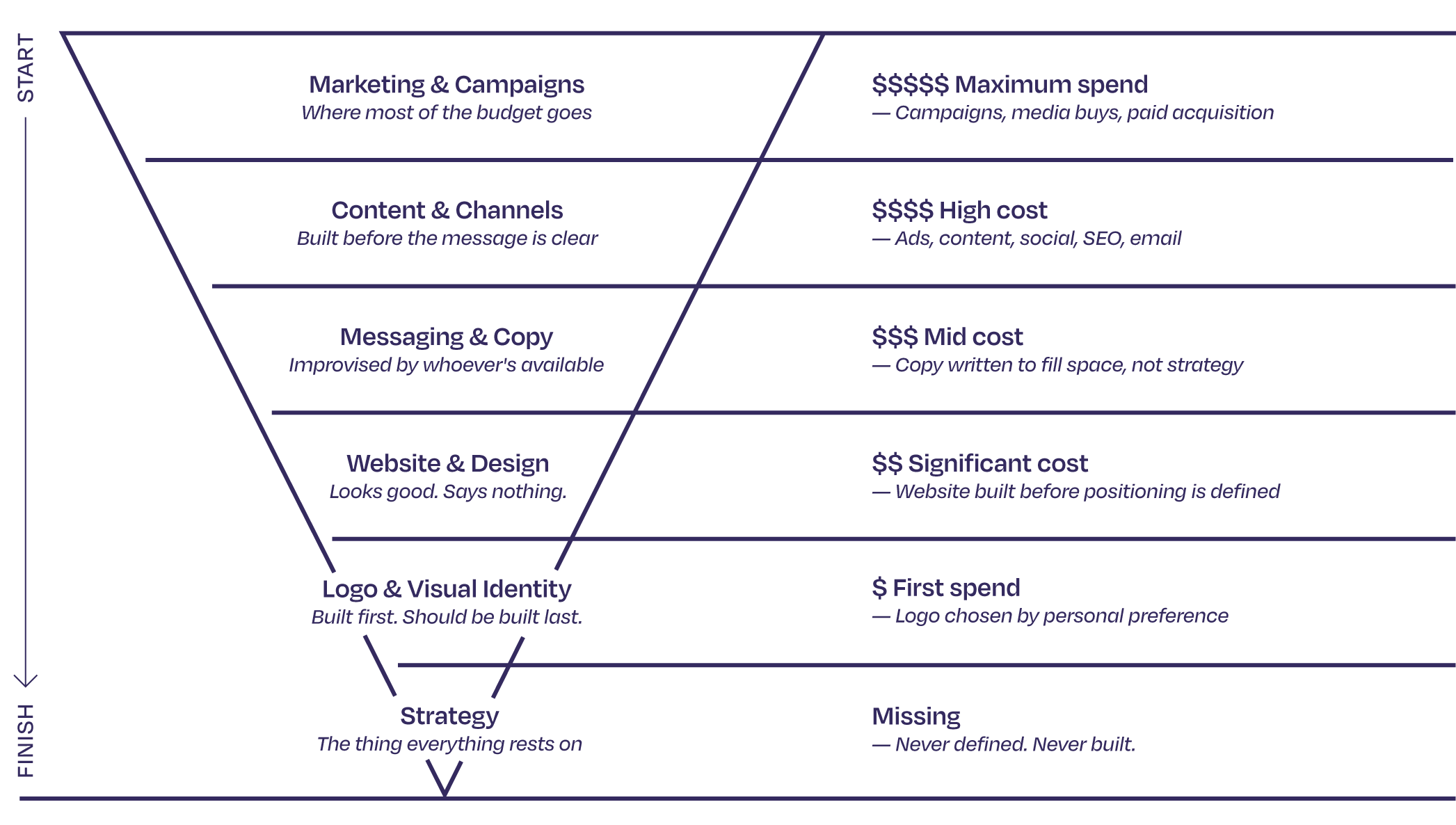
Marketing has to do strategy's job.
When positioning isn't defined, every campaign has to do two jobs — explain who the brand is and sell what it offers. That's expensive. And it's exactly why the numbers never add up the way they should.
Every campaign starts from zero rather than building on what came before it. Sales cycles get longer because the brand isn't doing the pre-selling it should. Spend increases because nothing is compounding. The marketing works harder and harder for results that should be getting easier over time.
The pyramid is upside down. And it stays that way until someone decides to flip it.
Design becomes subjective.
Without a strategic brief, design decisions come down to personal preference. Does the CEO like it? Does it feel premium? These are the wrong questions. The right question is: does this design express what the brand actually stands for?Without a strategy, that question can't be answered.
The sales team improvises.
When messaging isn't defined, every salesperson tells a slightly different version of the story. The brand drifts in every conversation. Trust is harder to build because consistency is impossible to maintain.
Rebrands become a cycle, not a solution.
Companies that build from the outside in tend to rebrand every three to five years. Not because the market changed. Because the brand was never built on anything solid enough to last.
Each rebrand follows the same pattern. A new logo. New colours. New website. A new agency brief that starts with the visual and hopes the strategy follows. The same sequence. The same result. And each cycle costs more than the last — not just in agency fees, but in lost brand equity, confused customers, and a team that stops believing the brand means anything.
The rebrand isn't the problem. Where it starts is.
What building from the inside out actually means
Building from the inside out isn't a design philosophy. It's a strategic discipline.
It means starting with the questions that are hardest to answer, and not moving forward until they're answered properly.
Who is this brand for, precisely?
Not a demographic. A person at a specific moment, experiencing a specific frustration, ready to make a change. The more precisely this is defined, the more clearly everything else can be built around them.
What is the brand's verified onlyness?
Not what makes it different in a general sense, what makes it the only choice for that specific person. The position it can claim that no competitor can credibly claim. This is what we call The Punch, the strategic core that everything else is built around.
What does the brand stand for, and what does it stand against?
A brand without a point of view is just a product. The brands that compound over time are the ones with a clear perspective on how the world should work — and the courage to say it out loud.
What is the brand's story?
Not its history. Its narrative. The journey it takes its audience on, from where they are now to where they want to be. The brand as guide, the customer as hero.
Only once these questions are answered does design begin. And when it does, design has something to express. The logo means something. The colours carry intent. The website has a clear job to do.

The cost of getting the sequence wrong
The gap between a strong brand and a weak one isn't talent, timing, or category. It's foundation.
According to Millward Brown / Kantar BrandZ analysis of consumer behaviour across thousands of brands, strong brands capture three times the sales volume of weak brands — and command a 13% price premium on top of that. The difference isn't the marketing budget. It's what's built underneath it.
Getting the sequence wrong isn't just an aesthetic problem. It has measurable business consequences.
— Marketing spend is less efficient.
— Sales cycles are longer.
— Talent decisions are harder.
— Growth is more expensive.
AI amplifies what's already there.
The arrival of AI in marketing has made the sequence problem more expensive, not less. AI tools can produce more content, faster. More campaigns, more copy, more targeting precision. But AI amplifies what's already there. If the brand underneath is unclear, inconsistent, or built in the wrong order — AI makes more of that. Faster. At scale.
The brands using AI effectively aren't the ones with the best tools. They're the ones with the clearest foundation. Strategy defined. Positioning locked. Message established. When those things are in place, AI has something real to work with. When they aren't, AI just gets you to the wrong place faster
The inside-out sequence
The correct sequence for building a brand looks like this:
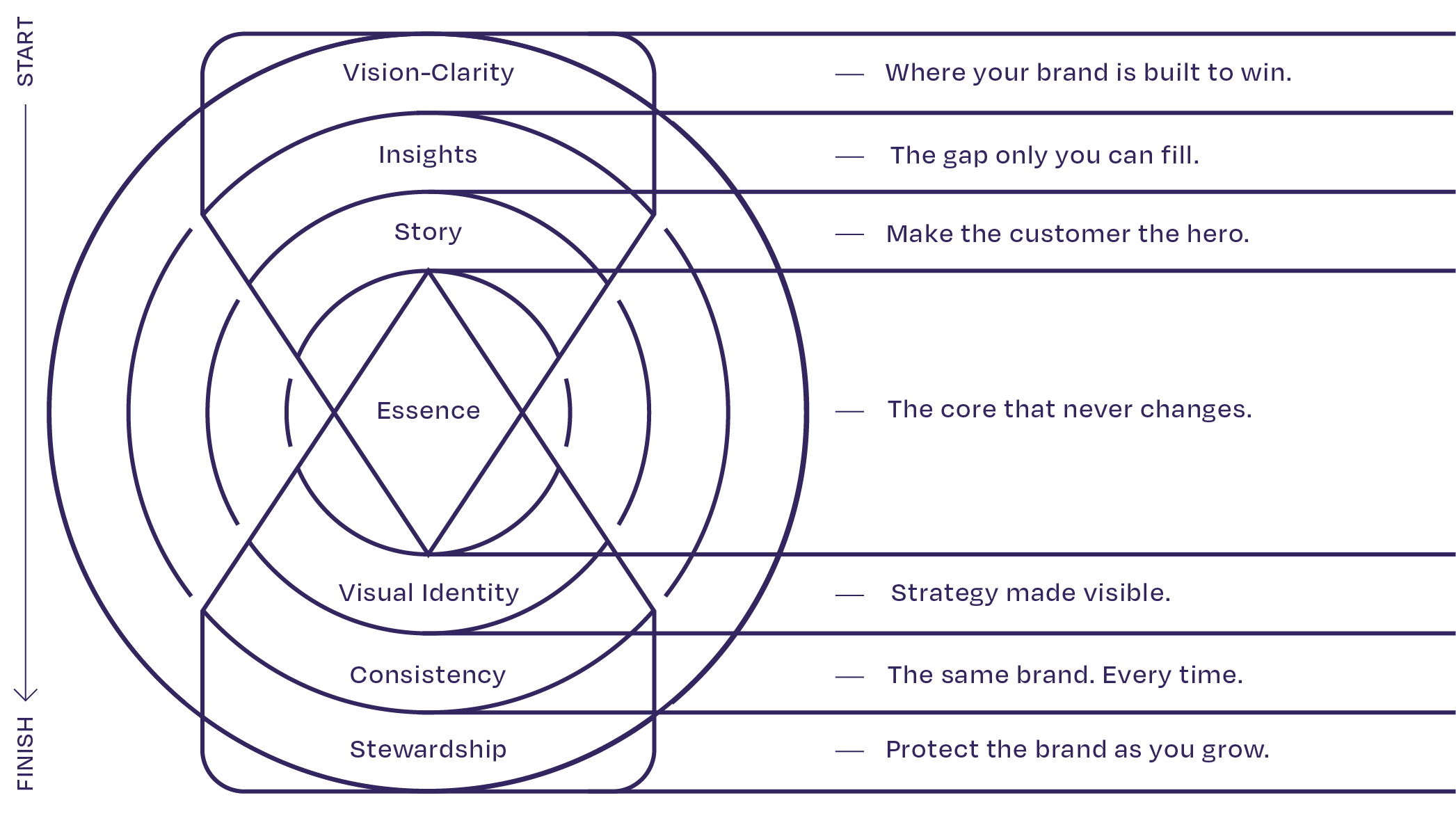
1. Vision-Clarity first.
Define The Punch — the verified onlyness. Map the audience with precision. Understand the competitive landscape. Build the insight that only this brand can claim.
2. Insights second.
Validate assumptions against reality. Customer empathy. Competitor mapping. The gap that only this brand can fill.
3. Story third.
Turn the strategic insight into a narrative. Define the positioning. Build the brand story framework. Give the brand a point of view worth listening to.
4. Essence fourth.
Distill everything into the emotional core. The internal compass. The thing that doesn't change when the market does.
5. Visual Identity fifth.
Now design begins. Visual identity, verbal identity, key visual — all built as expressions of what sits beneath them. Not preferences. Decisions grounded in strategy.
6. Consistency sixth.
Build the standards that make the brand repeatable at scale. The guidelines, templates, and filters that ensure every touchpoint reinforces the same message.
7. Stewardship last.
Protect and evolve the brand over time. The ongoing discipline that keeps the brand true as the business grows.
This is the sequence that makes marketing work. Not because the marketing is better, but because the brand behind it is built to carry it.
Why this is hard
The inside-out sequence is harder than the outside-in sequence. Not because the work is more complex, because the questions are more uncomfortable.
Defining a verified onlyness means making choices. It means excluding people who aren't the right fit. It means saying something specific enough that someone could disagree with it. It means the brand has to stand for something before it stands for everything.
Most companies avoid this. They'd rather have a logo that everyone likes than a position that the right people love.
But a logo everyone likes is a brand nobody remembers. The discomfort of the inside-out approach is the point.
The specificity that feels risky is exactly what makes the brand work.
How to know if your brand was built backwards
Ask yourself these questions:
- 1. Does your team struggle to explain what makes you different from competitors?
- 2. Does your marketing produce inconsistent results across channels?
- 3. Have you rebranded in the last five years without a clear strategic reason?
- 4. Does your logo feel disconnected from what your business actually stands for?
- 5. Are you spending on marketing but not seeing the growth you expected?
If you answered yes to two or more, your brand was probably built backwards. The good news is that the foundation can be built at any stage. It's never too late to build it right.
What to do next
Building from the inside out doesn't mean starting over. It means going deeper — finding the strategic core that should have been built first, and making sure everything built around it reflects it properly.
At Punch, this is where every engagement begins. We build the brand-system from the inside out, starting with The Punch and working outward through every layer, so when the marketing runs, it has something solid to amplify.
Read:
What is a brand-system, and why logos alone don't drive performance →
What is a Brand Operating System →
Brand Strategy on a Page, the one tool that holds the whole system together →
If this made you think about your own brand, let’s talk.
Book a free Vision Clarity Session