Most businesses build their brand from the outside in — starting with the logo and working backwards. A Brand Operating System flips that. It starts with The Punch — the brand's verified onlyness, the one position it can claim that no competitor can — and radiates outward through Essence, Service, Message, Identity, and Experience. When the core is right, everything built around it performs. When it's missing, everything built around it is decoration.

Marketing only works as hard as the brand behind it. Punch builds brand-systems from the inside out, so when you spend on marketing, it counts.
The mistake most businesses make
Most businesses start with the logo.
It feels like the right place to start. The logo is visible, tangible, and deliverable. It gives the impression that the brand is being built.
A logo without a core is just a mark. And a mark without meaning can't do the job a brand is supposed to do.
The reason most brands underperform isn't the logo. It isn't the colours or the website or the tagline. It's that none of those things were built on top of anything. There was no system holding them together. No verified core driving them outward.
That's what a Brand Operating System fixes.
What is a Brand Operating System?
A Brand Operating System — or BOS — is the complete structure of how a brand is organised, from its strategic core to its outermost expression in the world.
It has six concentric layers. Each one builds on the one inside it. Each one only works as well as what sits beneath it.
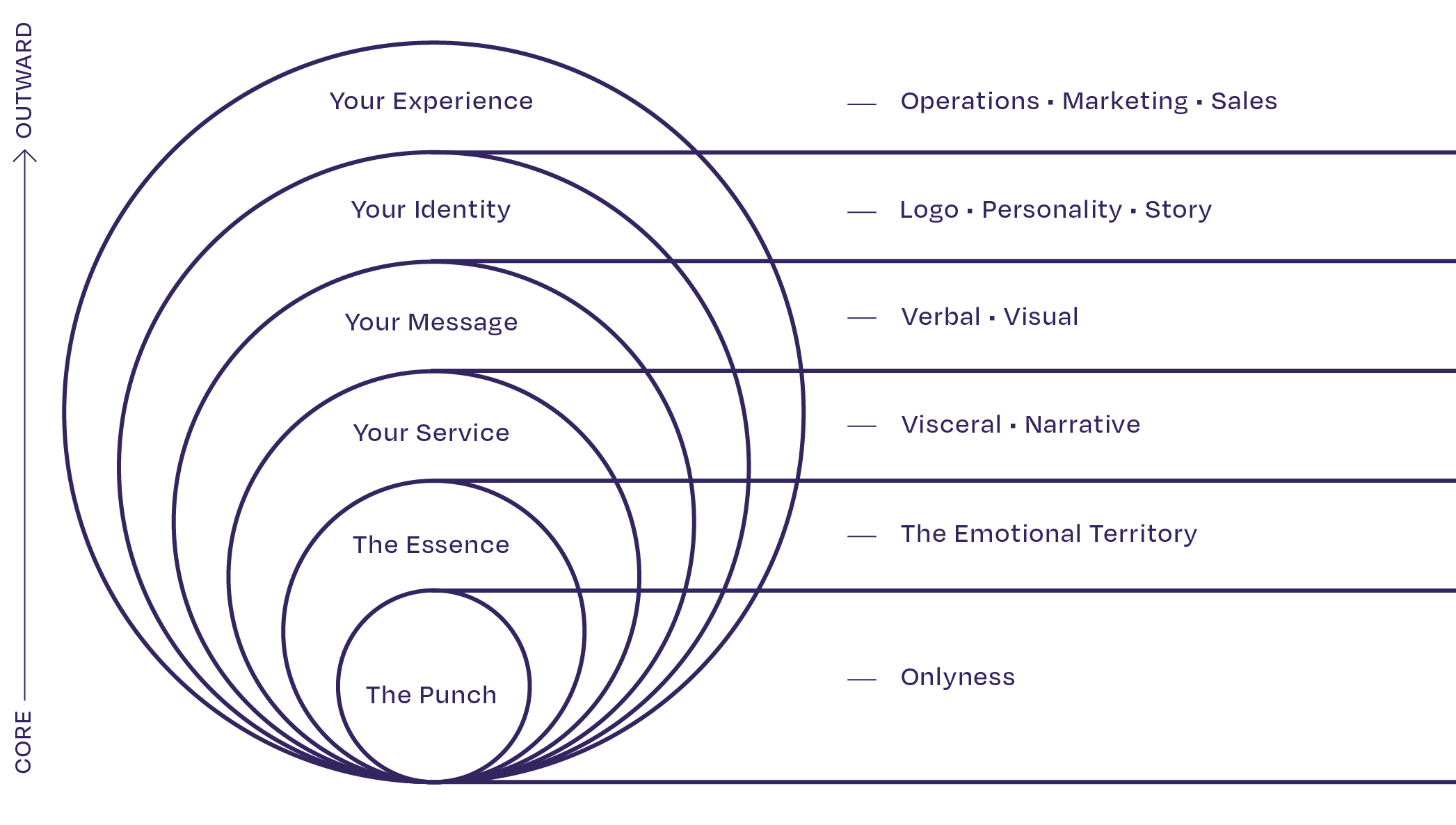
Think of it as a series of rings radiating outward from a single point. That point is everything. Get it right and every ring around it becomes stronger. Get it wrong — or skip it — and every ring around it becomes a guess.
The six layers of the Brand Operating System
1. The Punch — the verified onlyness
At the centre of every BOS is The Punch. This is the brand's verified onlyness — the one position it can claim that no competitor can. Not a tagline. Not a mission statement. A precise, tested articulation of what makes this brand genuinely, provably different.
The Punch is verified — not assumed. It survives what we call the Kill Test:
If a competitor could say the same thing, it isn't The Punch.
It has to be true, it has to be ownable, and it has to be the thing the entire brand is built around.
Everything else in the BOS radiates from this point. Which means if The Punch is wrong — or missing — every layer built around it is built on sand.
2. Essence
Essence is the emotional and strategic translation of The Punch. It's what The Punch feels like — the internal compass that guides every brand decision without having to revisit the strategy each time.
Essence is what stays constant when channels change, when team members change, when the market changes.
It's the unchanging centre that keeps the brand coherent over time.
3. Your Service
The Service layer is where The Punch and Essence become tangible in what the business actually delivers. It's the visceral experience of the brand — how working with this business feels, and the story it tells through the quality and nature of its service.
This is where brand stops being strategic and starts being experiential. The brand promise meets the business reality here.
If there's a gap between what the brand claims and what the service delivers — this is where it shows.
You have brand assets. A logo. A website. Maybe a tagline.
What you might not have is the system underneath them — the verified core that makes every outer layer perform. That's exactly what a Vision Clarity Session establishes. Where your brand's core currently stands, and what it would take to build the system around it properly.
Book a Free Vision Clarity Session →
4. Your Message
The Message layer is how the brand speaks. It has two dimensions — verbal and visual.
Verbally: the words, tone, and narrative the brand uses consistently across every touchpoint. Not just what it says but how it says it — the personality that comes through in every piece of communication.
Visually: the graphic language that carries meaning before words are read. Colour, imagery, layout, and the visual grammar that makes the brand instantly recognisable.
Message is where strategy becomes communication.
When it's built on a clear Essence and a verified Punch, it's focused and consistent. When it isn't, it drifts.
5. Your Identity
Identity is the formal system that holds Message together. Logo, personality, and story — the complete set of brand assets that give the brand a face, a voice, and a history.
This is the layer most businesses start with. In the BOS it sits fifth — because everything in the Identity layer should be an expression of what sits beneath it. A logo built on top of a clear Punch and a defined Essence means something.
A logo built in a vacuum is just a shape.
6. Your Experience
The outermost layer is Experience — the total impression the brand makes across every point of contact with the world. Operations, marketing, and sales are all part of this layer.
This is where the brand becomes real for the people it serves.
Every invoice, every pitch, every social post, every customer interaction is an expression of the Experience layer. When the five layers beneath it are solid, the Experience layer is consistent and compelling. When they aren't, it's inconsistent and confusing.
Why the order matters
The instinct is to start at the outside and work in. Build the logo. Design the website. Run the marketing. Then figure out what the brand actually stands for.
This is backwards — and it's expensive.
When you build from the outside in, every outer layer has to carry the weight of the missing inner layers.
The marketing has to explain the positioning. The logo has to convey the personality. The sales team has to articulate the differentiation. None of these things were designed to do that job.
When you build from the inside out — starting with The Punch and working outward — each layer only has to do its own job. The Punch carries the strategy. The Essence carries the feeling. The Service carries the promise. The Message carries the voice. The Identity carries the recognition. The Experience carries the relationship.
The whole system works because each part is supported by what sits beneath it.
How the BOS connects to everything the business does
A Brand Operating System isn't just a branding tool. It's a business operating tool.
When The Punch (onlyness) is clear, sales conversations are shorter — because the differentiation is already established before the meeting starts.
When Essence is defined, hiring decisions are easier — because you know what kind of person belongs in this brand.
When Message is consistent, marketing performs better — because every campaign reinforces the same clear signal rather than starting from scratch.
When Identity is built on strategy, design decisions are faster — because there's a system to reference rather than a preference to debate.
When Experience is aligned, retention improves — because clients feel the same coherent brand at every touchpoint, not a different version of it each time.
The BOS doesn't just make the brand better. It makes the business easier to run.
The Punch is where it starts — and where it all comes back to
Every layer in the BOS can be refined, updated, or evolved over time. Messaging can be sharpened. Identity can be refreshed. Experience can be improved.
The Punch is the one thing that shouldn't change — because it's the one thing that's genuinely true and genuinely ownable. When it's right, it's the competitive advantage that compounds. Every layer built around it makes it stronger. Every impression the brand makes reinforces it.
This is why the logo is the last thing to build — not the first.
The logo is the visible tip of a system. Build the system first. The logo will mean something.
What to do next
Most businesses don't have a Brand Operating System. They have brand assets — a logo, some colours, a website, a tagline. These are the outputs of a system. Without the system, they're just decoration.
At Punch, building the BOS is how we start every engagement. The Punch is verified first. Everything else is built around it — in sequence, from the inside out.
Read:
What is a brand-system — and why logos alone don't drive performance →
Brand SOAP — the one tool that holds the whole system together →
If this article made you think about your own brand, that's worth a conversation.
Book a Free Vision Clarity Session →