Brand performance is what your brand actually produces, not how it looks. Track and score 7 real signals with the Brand Performance Score to find out if your brand is doing its share of the work, or if marketing is carrying it alone.

Most founders can tell you their revenue, their margins, and their customer acquisition cost down to the dollar. Ask if their brand is working, and the answer is usually a shrug — or a guess dressed up as confidence.
That's not a knowledge gap. It's a measurement gap. Brand performance gets treated like a feeling instead of a function, so founders manage it by instinct: a new logo when things feel stale, a rebrand when growth slows, a bigger ad budget when the phone stops ringing. None of that is performance management. It's guessing with a bigger invoice attached.
Brand performance, defined
Brand performance is the measurable effect your brand has on business outcomes — not how it looks, what it produces.
A brand performs when it does one or more of the following, consistently, without you having to force it:
- Lets you charge more than a generic competitor for a comparable product or service
- Shortens the time between first contact and closed sale
- Brings in customers who were referred rather than chased
- Keeps customers around longer, and gets them to buy again
- Makes marketing spend go further, because the audience already has a reason to say yes
- Attracts the right people to work for you, without a recruiter chasing them down
Every one of those is a business result. None of them is a design opinion.
Why brand performance gets confused with brand awareness
Marketing dashboards are full of numbers that feel like proof of a working brand: impressions, followers, likes, reach. Easy to track, satisfying to watch climb, and almost useless as evidence a brand is performing.
Awareness tells you how many people saw something. Performance tells you what those people did as a result, and what it cost you to make them do it. Plenty of highly visible companies have gone under with millions of followers. Visibility without conversion, retention, or pricing power isn't a performing brand. It's an expensive habit.
Kantar tracks a portfolio of the world’s strongest brands against the market. From April 2006 to March 2025, that portfolio returned 435%, against 353% for the S&P 500.

The real signals that your brand is working
Seven signals, harder to fake than a dashboard and far more honest about what's actually happening.
1. Price tolerance.
Can you charge more than an unbranded competitor for the same core offer, and have customers accept it without a fight? If every sale is a negotiation on price, the brand isn't doing enough of the selling.
2. Sales cycle length.
A brand that's done its job pre-sells trust before the sales conversation starts. If every deal takes the same long, uphill effort to close regardless of how well-known you are, the brand isn't reducing friction — it's absent from the process.
3. Referral rate.
Referred customers are the clearest evidence a brand is performing, because someone staked their own reputation on recommending you. Almost no organic referrals means you're relying entirely on paid reach to do the brand's job.
4. Marketing efficiency.
Track cost per customer over time, not in isolation. A performing brand makes each campaign more efficient than the last, because audiences increasingly recognize and trust the source. Flat or climbing costs no matter how much you spend means the brand isn't compounding — the media buy is doing all the work.
5. Retention and repeat purchase.
Acquiring a customer is a marketing outcome. Keeping them is a brand outcome. Customers leaving at the same rate as they would with an unbranded competitor means the brand isn't creating loyalty — it's an acquisition cost with a logo on it.
6. Unprompted recognition.
Can customers describe what makes you different without being fed the language first? If every accurate description had to be scripted for them, the positioning hasn't landed.
The furthest version of this is a brand becoming a verb — "let's Google it," "let's Uber there," or, closer to home, a client saying "let's Punch it" instead of asking for a rebrand by name. This isn't reserved for global giants. A brand doesn't need to be known everywhere to become the default shorthand for the action itself — it just needs to be the obvious reference point inside its own market.
7. Talent pull. Strong brands don't only sell to customers — they attract the people who want to build them. A consistently hard, expensive hiring search is a brand performance problem showing up on the wrong balance sheet.
None of these require a marketing degree to track. They require honesty about what's actually happening versus what you'd like to believe is happening.
Why branding helps marketing work
Two companies can spend the same marketing budget and land two different outcomes. It's rarely the media plan. It's what the media plan is sitting on top of.
Marketing works when it's compounding on something already built — a clear position, a kept promise, a consistent experience. Add spend to that, and every campaign builds on trust the last one earned. Add the same spend to nothing, and it resets to zero every time out, because there's no foundation underneath it to build on.
That's the logic behind building brands from the inside out, so when you spend on marketing, it counts — see how the layers connect in The Brand Operating System.
Consistency is part of that foundation, not decoration on top of it. Brands that hold a genuinely consistent system across every channel see a measurable revenue lift over brands that let each touchpoint drift — one of the most under-audited drivers of performance most businesses have.
Trust is not a soft metric — it's a leading indicator
Price tolerance, referrals, and retention are the lagging evidence of a performing brand. Trust is the leading one. According to the 2025 Edelman Trust Barometer, 80% of people say they trust the brands they use — a higher share than trust business, media, government, NGOs, or their own employer. That level of trust is earned through consistent delivery on a promise, not a clever tagline.
If you want to predict whether your brand will perform six months from now, don't just ask whether people have heard of you. Ask whether the people who've already bought from you trust what happens next. That answer shows up later in referrals, retention, and price tolerance — but it's visible now, if you're honest about looking.
How to actually know if your brand is working
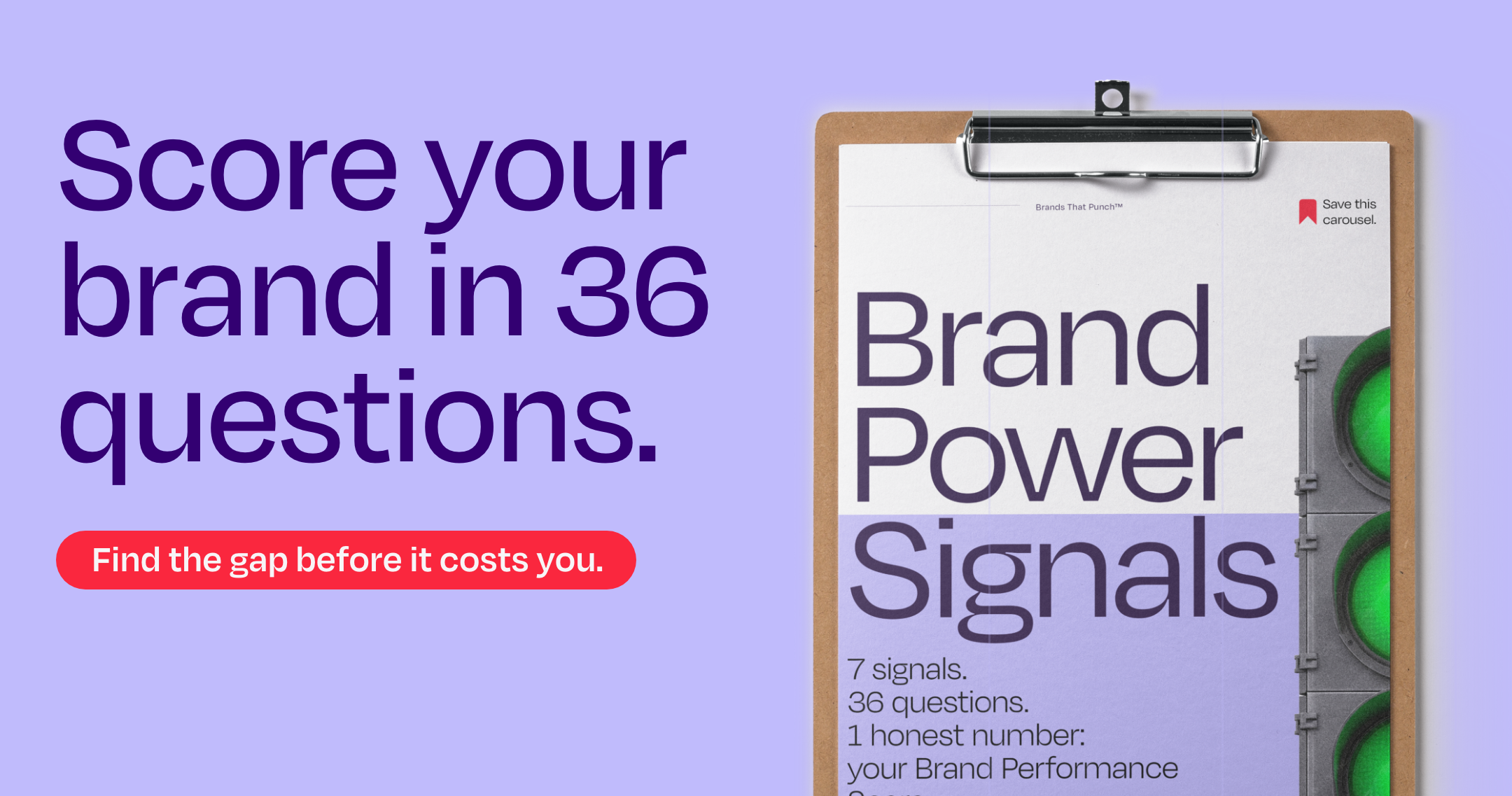
Run this as a five-minute gut check before you spend another dollar on marketing:
- Pull your last 20 customers. How many came from a referral versus paid or cold outreach?
- Compare your pricing to the nearest unbranded or generic competitor. Premium, matching, or undercutting to compete?
- Ask three customers to describe what makes you different — without prompting them. Do their answers sound like your positioning, or nothing like it?
- Look at cost per customer over the last four quarters. Trending down, flat, or climbing?
- Check repeat purchase or renewal rate against your industry average. Ahead, in line, or behind?
Uncomfortable answers mean the brand isn't the finishing touch on your marketing — it's the missing infrastructure underneath it. Not a copywriting problem or a logo problem. A systems problem, fixed at the layer where it started, not the layer where it became visible.
The bottom line
Brand performance isn't a feeling, and it isn't a follower count. It's a set of measurable business outcomes — price tolerance, sales velocity, referrals, retention, marketing efficiency, recognition, and talent pull — that either compound in your favour or quietly work against you every day the brand goes unmanaged.
Most businesses don't find out which one is happening until growth stalls and nobody can explain why. The ones that find out early are asking the right questions of the right layer, instead of assuming the answer is always "more marketing."
Want a fuller picture of where your brand-system might be leaking performance? Start with the brand diagnostic tool or read how the six layers connect in The Brand Operating System.
What to Do Next
Most businesses don't have a Brand Operating System. They have brand assets — a logo, some colours, a website, a tagline. These are the outputs of a system. Without the system, they're just decoration.
At Punch, before we recommend a fix, we measure the system underneath it. The Brand Operating System is verified first — the layers that actually drive performance, not the outputs that sit on top of it. A low score on any signal is a sign something's off upstream — the audit is how you find out what.
Read:
What is a brand-system — and why logos alone don't drive performance →
Brand SOAP — the one tool that holds the whole system together →
MVB — The system brands actually need →
See how we build it inside the BrandsThatPunch™ process →
Scoring low isn't a verdict on which fix you need. Refine, reposition, and rebrand solve different problems, and confusing them is how businesses spend the most money for the least result.
Sources:
If this made you think about your own brand, let’s talk.
Book a free Vision Clarity Session