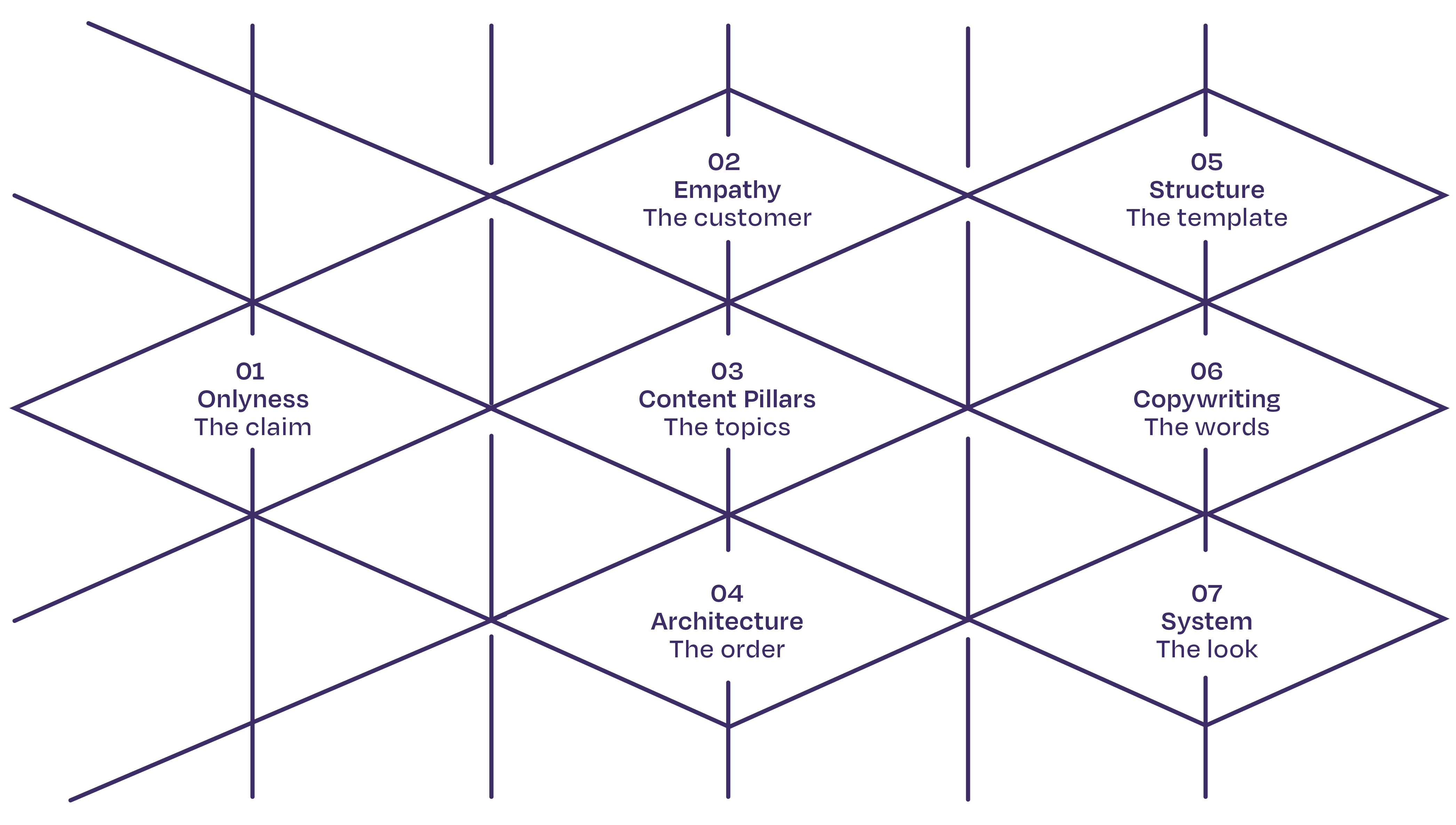
Content that performs is built in seven layers, in order: Onlyness, Empathy, Content Pillars, Architecture, Structure, Copywriting and System.
Each layer rests on the one below it. When one is missing, everything above it works from a guess.
The lowest layer that isn’t working is your first domino.
Fix that one first.

Most founders start content at the top. They open a design app, pick a template, write a caption and post it. A few weeks later the posting slows down, then stops. Nothing much happened, and nobody can say why.
The problem usually sits several layers below the post, in decisions made before anyone opens a design app.
Content that performs is built from the bottom up, in a fixed order, with each decision resting on the one beneath it.
What is a content stack?
A content stack is the ordered set of decisions a brand makes to produce content. It starts with what makes the brand different and ends with how the finished piece looks. At BrandsThatPunch™ it has seven layers, and each one answers a question the buyer is already asking:
- Onlyness — Why you, not them?
- Empathy — Do they get my problem?
- Content Pillars — Do they know their stuff?
- Architecture — What should I read next?
- Structure — Is this easy to follow?
- Copywriting — Do I believe this?
- System — Can I trust them?
Each layer produces one thing you can point to: a statement, a map, a list, a plan, a template, a draft, a finished asset. Each one depends on the layer below it.
When a layer is missing, every layer above it is working from a guess.
Where this fits
This is the ninth and final article in our brand-systems series. The first eight were about building the brand itself:
- What is a brand-system
- Why most companies build their brand backwards
- What is a Brand Operating System
- How to build a brand position worth owning
- Brand Strategy on a Page (SOAP)
- MVB: the system brands actually need
- Brand performance: how to score yours
- Rebrand, reposition or refine?
The Brand Operating System defines what your brand is. The Content Stack is how that brand gets turned into content, week after week. You can use this article on its own. You'll get more from it if you've read the others.
Why most content doesn't perform
Having a content strategy is no longer rare. In the Content Marketing Institute's research for 2026, 97% of the B2B marketers surveyed said they had one. Only 12% rated their marketing as highly effective.
Tools aren't the missing piece either. Almost nine in ten marketers using AI already use it to write content. Among those using it for content creation, 87% say productivity went up. Only 39% say content performance improved, and 12% say quality dropped. Faster output hasn't turned into better results for most teams.
When CMI asked effective teams what made the difference, the top answer was content relevance and quality, at 65%. Relevance comes from knowing what you stand for and who you're talking to. Quality comes from standards. Both are decided before anyone writes a word, in the lower layers of the stack.
The seven layers
— 01 Onlyness
What it is:
The one position your brand can claim that no competitor can.
What it produces:
Your Onlyness Statement.
The buyer asks: Why you, not them?
Everything in the stack is built on this. Without it, your content covers the same topics, in the same tone, with the same advice as everyone else in your category. It's a common problem. In the same CMI research, 24% of B2B marketers named differentiating their content from competitors as a top challenge.
The check is the Kill Test. If a competitor could publish the same post with their logo on it, it isn't built on your Onlyness.
We cover how to find and verify it in How to build a brand position worth owning. For the Content Stack, you only need the output: one clear statement every piece of content can be measured against.
Signs this layer is missing:
your posts could run on a competitor's page without anyone noticing.
— 02 Empathy
What it is:
A working understanding of what your customer says, thinks, feels and does.
What it produces:
A customer empathy map.
The buyer asks: Do they get my problem?
The empathy map is a design-thinking tool, developed by Dave Gray at the consultancy XPLANE. It splits what you know about a customer into four boxes: says, thinks, feels, does.
The useful part is the gap between the boxes. What a customer says on a sales call is often different from what they think on the drive home. A founder might say "we need a new logo" while thinking "our prices keep getting pushed back and I don't know why." Content written to the second sentence is the content that gets read.
Buyers notice when you've done this work. In the 2025 Edelman-LinkedIn B2B Thought Leadership Impact Report, 85% of decision-makers said a demonstrated understanding of their business's specific challenges and needs mattered most when finalising a purchase.
How to build it:
Take five recent customer conversations: sales calls, emails, reviews, support tickets. Write their exact words in the "says" box. Fill the other three from what you observed and what they told you later. Keep their language as it is. The phrases customers use are the phrases they type into search and ask AI assistants, so the "says" box doubles as a list of ready-made headlines.
Signs this layer is missing:
your content answers questions nobody is asking.
— 03 Content Pillars
What it is:
The three to five topics your brand owns.
What it produces:
A short list, with one line per pillar describing what's in and what's out.
The buyer asks: Do they know their stuff?
Pillars sit where your Onlyness and your empathy map overlap, and each one has to earn its place twice. It must connect to what makes you different, and it must answer something your customer needs. A topic that only does the first is self-promotion. A topic that only does the second helps the reader but builds your category's authority as much as yours.
Take a heating and cooling company in Moncton whose Onlyness is fixed-price installs backed by a ten-year labour guarantee. Its pillars might be: choosing between a heat pump and a furnace, what an installation really costs, and keeping a system running through a Maritime winter. Every one ties back to price certainty and long-term reliability. Every one answers a question its customers already ask.
Fewer pillars means more depth in each. Depth is what gets a brand recognised as the answer on a subject, by people and by answer engines.
Tag each pillar to a stage. Owning a topic isn't the same as covering the whole journey on it. For each pillar, mark whether it speaks to someone who's just noticed a problem (awareness), someone comparing options (consideration), or someone ready to choose (decision). In the heating example: "heat pump vs. furnace" is awareness, "what installation really costs" is consideration, the ten-year guarantee is decision. Lay the tags out next to each other and gaps become obvious fast — most brands are heavy on awareness and thin on decision content, which is exactly where a sale stalls. In CMI's 2026 research, 23% of B2B marketers named aligning content with the buyer's journey a top-three challenge. The fix isn't a new layer, it's a second column on the list you already have.
Signs this layer is missing:
You post whatever's trending, a regular reader couldn't say what you're known for, or everything you've published only ever speaks to someone who's just found out they have a problem.
— 04 Architecture
What it is:
The order your content gets built in.
What it produces:
A series map.
The buyer asks: What should I read next?
Pillars tell you what to write about. Architecture tells you what to write first. Build pieces in the order a reader needs to understand them, so each one stands on the one before it and links back to it.
This is the order you build in, not the order a single reader moves through on their way to a decision. That's a different question, and it's answered back in Pillars, by the stage tag on each topic. Architecture sequences your production. The stage tags sequence your reader's journey. Confuse the two and you'll build a publishing calendar shaped like a sales funnel, when what you actually need is a body of work with no gaps in it.
This series is an example. It opens with what a brand-system is, moves through why most companies build backwards, the Brand Operating System, Onlyness, strategy, the Minimum Viable Brand, performance and the rebrand decision. The Content Stack comes last because it depends on everything before it. Published in a different order, half the articles would have to re-explain the basics.
Architecture matters for search too. A set of connected articles on one subject, linked to each other, gives search engines and AI assistants a clearer picture of what you know than the same articles scattered across a year of unrelated posts.
Signs this layer is missing:
articles that repeat each other's introductions, with no links between them.
— 05 Structure
What it is:
The repeatable format every piece of content moves through.
What it produces:
A production template.
The buyer asks: Is this easy to follow?
Decide the formats your content moves through, and use the same sequence every time. A core piece comes first, and the shorter formats are built from it. Plan the repurposing before the core piece is written, so the shorter formats are designed in from the start instead of squeezed out of whatever's left.
This layer is mostly about capacity. Resource constraints (time, people, budget) were the second most-cited content challenge in CMI's research, at 39%. A fixed structure means no week starts from a blank page.
Choose formats that match where your buyers already spend time. For B2B, marketers rated LinkedIn (76%) and email newsletters (54%) as the two most effective channels for thought leadership.
Signs this layer is missing:
Every post is a one-off, and content stops the first busy week.
— 06 Copywriting
What it is:
The words, written to a standard.
What it produces:
A draft that passes your standard.
The buyer asks: Do I believe this?
Most businesses treat writing as the whole job. In the stack it's layer six, because by the time you write, the hard decisions are made. You know what you stand for, who you're writing to, what the topic is, where it sits in the series and what format it's going into. The writing gets faster and better.
The standard is what makes this a layer instead of a task. Ours has three rules. Write for a cold reader: a founder who has never heard of us and thinks branding means a logo. Verify every statistic at its original source, or cut it. Remove any phrasing that sounds assembled instead of written.
That last rule matters more every year. AI can draft quickly, but the CMI numbers show speed and quality aren't moving together. Given a thin brief, AI produces the average of everything it has read, which is exactly the content your Onlyness is meant to separate you from. Given layers one to five, it has something real to work with.
Signs this layer is missing:
Copy that could belong to any company in your category, and statistics nobody can trace.
— 07 System
What it is:
the visual rules every piece is built with.
What it produces:
The finished asset. Brand Standards Manual.
The buyer asks: Can I trust them?
Colour, type, layout, templates and identity elements, applied the same way every time. System sits at the top because it's the layer people see first and the one that means least without the rest.
Design on an empty stack can look good and still say nothing.
Design on a full one makes your content recognisable before anyone reads it. Research on distinctive brand assets from the Ehrenberg-Bass Institute points the same way: recognition is built by using the same cues consistently over time, and a fresh look for every post works against it.
It's the same principle as the Brand Operating System, where identity is built after the strategy underneath it.
Signs this layer is missing:
Every post looks different, and nobody knows it's yours until they see the name.
The Stack Check
Answer yes or no for each layer. Be strict. "Sort of" counts as no.
1. Onlyness:
Can you state, in one sentence, what your brand can claim that no competitor can?
2. Empathy:
Do you have your customers' own words written down: what they say, think, feel and do?
3. Content Pillars:
Could a regular reader name the three to five topics you're known for, and does at least one piece per pillar speak to someone ready to decide, not just someone who's noticed a problem?
4. Architecture:
Is there a planned order to what you publish, with pieces linking to each other?
5. Structure:
Does every piece of content move through the same repeatable format?
6. Copywriting:
Do you have written standards every draft has to pass before it's published?
7. System:
Would someone recognise your content before they saw your name?
Your lowest "no" is your first domino. Fixing a higher layer while a lower one is broken makes content look better without making it work better.
A new template won't fix missing pillars, and a good copywriter can't write around a missing Onlyness.
This yes/no check is the quick version. The full audit we run on websites scores each layer out of 10.
If your first "no" is layer one, start with the Brand Operating System or the Minimum Viable Brand. If you already have a Brand Strategy on a Page, most of layers one to three are done. Your Onlyness, your customer and your priorities are already on the page.
BrandBase™ Score
We use the Content Stack on every brand we work with, and we take it seriously enough that we wanted a number for it. So we built one. What started as an internal check is now a service of its own.
Introducing the BrandBase™ Score.
The BrandBase™ Score measures how well a website carries a brand, and it's built on the Content Stack. Each of the seven layers gets a score out of 10, and the lower layers count for more: Onlyness is weighted three times, Empathy and Content Pillars twice, the other four once. The score also tests whether AI search tools find the business when customers ask questions.
A brand agency's website should show the method working, so we ran our BrandBase™ Score on ours. The BrandBase™ Score measures how well a website carries a brand, and it's built on the Content Stack. Each of the seven layers gets a score out of 10, and the lower layers count for more: Onlyness is weighted three times, Empathy and Content Pillars twice, the other four once. The score also tests whether AI search tools find the business when customers ask questions.
We scored 6.5 out of 10. Onlyness was in place, and our first domino was Empathy: the site didn't show a buyer what an engagement involves, how long it takes or what it costs. The first domino is the lowest layer that isn't working, and every layer above it depends on it, so fixes go in from the bottom up.
We worked through the list, lowest layer first. Our site now scores 8 out of 10, and that is an extremely good score. On our scale, an 8 means clear and consistent, with small gaps. It takes work on all seven layers, and the foundation layers carry the most weight.
That's what the BrandBase™ Score is for. It shows which layer to fix first, so the work goes where it changes the score, and it gives you a number to check again after the fixes.
Why a website can't score a 10
A 10 means clear, consistent, and hard for a competitor to copy. Words on a page are easy to copy, and a competitor can lift a headline in an afternoon. The audit also reads only what the site says. It can't see whether a claim is true, so it can't tell a real Onlyness from a well-written one.
What can't be copied is proof and time. Getting to a 10 would take:
1. Onlyness backed by evidence:
- Client results, published numbers, and a method people name as yours.
2. Empathy kept current:
Customer conversations that keep feeding the map, not a map made once.
3. Years of consistency:
- The same structure, standards and visual system, applied the same way until people recognise the work before they see the name.
4. AI tools naming you:
- Your brand coming up as the answer to your customers' questions, without being prompted.
Most of that happens outside the website, and some of it only comes with time.
Frequently asked questions
What is a content stack?
A content stack is the ordered sequence of decisions behind content production. BrandsThatPunch™ uses seven layers: Onlyness, Empathy, Content Pillars, Architecture, Structure, Copywriting and System. Each layer depends on the one below it.
What's the difference between a content strategy and a content stack?
A content strategy usually sets out goals, audience and channels. A content stack puts every production decision in dependency order and gives each one a finished output, so when content underperforms you can see which layer is missing.
What is the first domino?
The lowest layer in the stack that isn't working. Each layer depends on the one beneath it, so that's the layer to fix first.
How many content pillars should a brand have?
Three to five. Each pillar should connect to your Onlyness and answer a real customer need. More than five usually means some pillars are too thin to build authority.
How does the content stack align with the customer journey?
It doesn't sit in a separate layer. Each content pillar is tagged by the stage it serves — awareness, consideration or decision — so the pillar list doubles as a journey map. Architecture, by contrast, is the order pieces get built in, not the order a reader moves through them.
Can AI build a content stack?
AI can help with layers five and six: repurposing and drafting. It can't decide your Onlyness or understand your customers for you. Without the lower layers, AI tends to produce content that sounds like everyone else's.
Where does design fit in a content strategy?
Last. Design is the visual system applied to content that has already been decided. Starting with design is the content version of building a brand logo-first.
Do small businesses need a content stack?
Yes, and it's often simpler for them. A founder-led business can fit layers one to three on a single page and run a basic weekly structure. The stack gets smaller for a small business. The order stays the same.
Built in order
This series started with the idea that a brand is built from the inside out, with the logo last. Content works the same way. Build the lower layers first, and every post you publish has something underneath it.
Sources:
- — Content Marketing Institute and Marketing Profs, B2B Content and Marketing Trends: Insights for 2026 (survey of 1,015 B2B marketers, fielded June–August 2025). contentmarketinginstitute.com/b2b-research/b2b-content-marketing-trends-research
- — Edelman and LinkedIn, 2025 B2B Thought Leadership Impact Report (nearly 2,000 global professionals). edelman.com/expertise/Business-Marketing/2025-b2b-thought-leadership-report
- — Dave Gray, XPLANE: empathy map (design-thinking tool)
- — Ehrenberg-Bass Institute for Marketing Science: research on distinctive brand assets (Jenni Romaniuk)
If this article made you think about your own brand, that's worth a conversation.
Book a Free Vision Clarity Session →