Something's wrong with your brand, but rebranding isn't automatically the fix. Underperformance can start at three different depths: inconsistent execution (Refine), a claim the market's outgrown (Reposition), or an internal compass that's genuinely shifted (Rebrand). Each has its own tell, its own cost, and its own fix. Picking the wrong one doesn't just waste budget, it leaves the real problem untouched. Maintain, Rename, Retire, Architecture, Merger, and Founder Exit are related but separate decisions this framework doesn't cover.

Most businesses that sense something's wrong with their brand reach for the same fix: rebrand. New logo, new name, new website, twelve months and a number with a lot of zeros on the end. Sometimes that's exactly right. More often it's the most expensive way to solve a problem that started somewhere else entirely.
The mistake isn't in noticing something's off. It's in treating every symptom as if it has one cause and one fix. A brand that isn't performing can be underperforming for three genuinely different reasons, and each one calls for a different repair — at a different depth, at a different cost, touching different layers of the business.
If you want a starting point for where your own brand stands before reading further, the Brand Audit Tool will score it across all six layers. But the framework below works whether or not you've run that yet — it's about knowing which of three paths applies once you've noticed the problem, however you noticed it.
Refine, reposition, and rebrand are three different operations. They fix three different kinds of failure. Picking the wrong one doesn't just waste budget — it leaves the actual problem untouched while the business spends on the wrong layer and wonders why nothing changed.
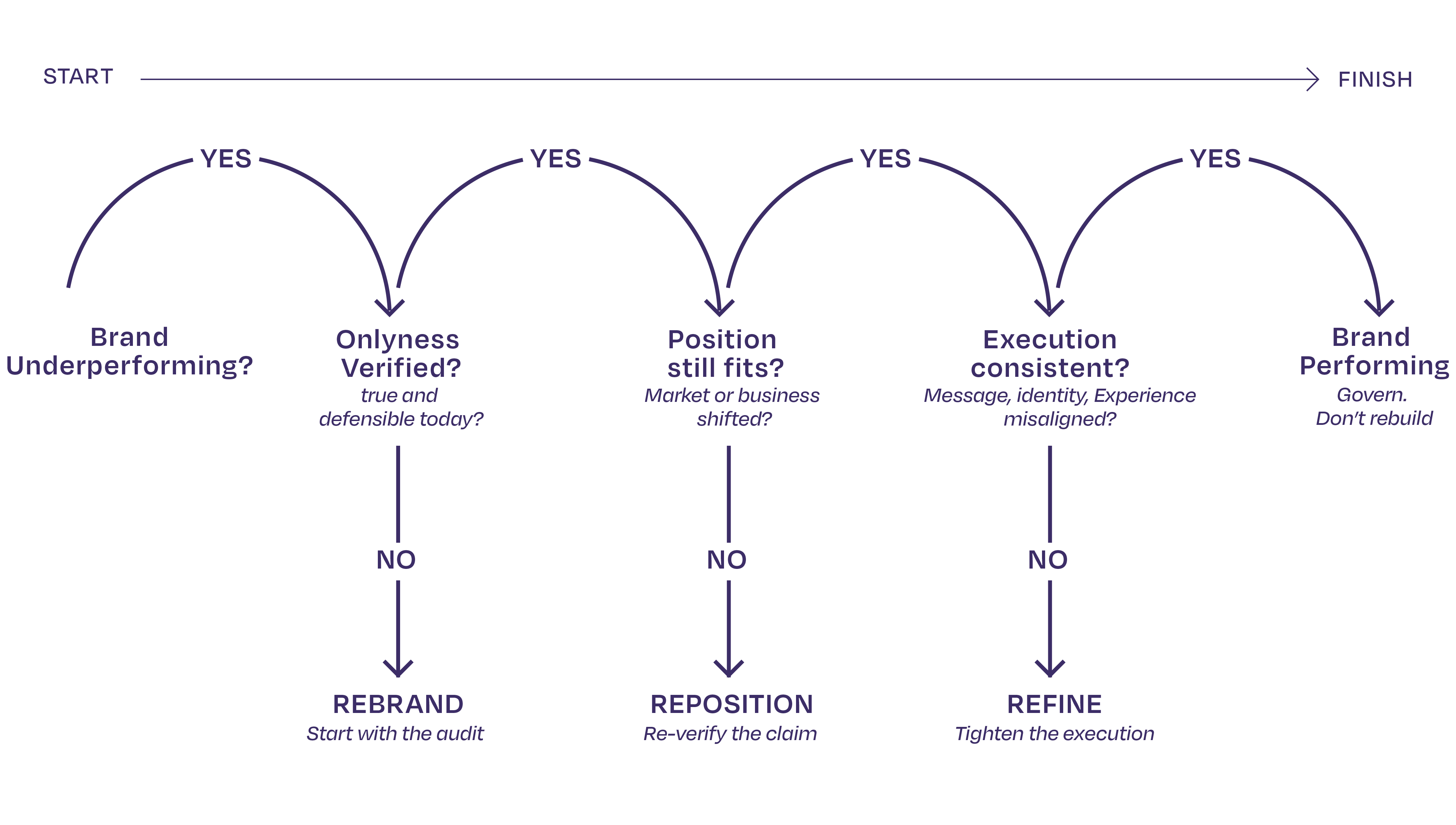
Why the wrong choice costs more than the right one
Every brand-system has six layers: Onlyness, Essence, Service, Message, Identity, Experience. Each one builds on the one before it. When a brand underperforms, the visible symptom almost never sits at the layer where the problem started — it shows up downstream, usually in Message or Identity, because that's what customers actually see.
A business that notices weak visuals and inconsistent messaging will naturally reach for a rebrand. But if the Onlyness is sound and the Essence is sound, a rebrand replaces layers that were never broken while leaving the founder no closer to knowing whether the actual issue was ever addressed. The new logo looks better. The underlying confusion is still there, just better dressed.
This is the same logic behind The Brand Operating System: sequence is the argument. The fix has to start at the layer the problem came from, not the layer where it became visible.
Refine — When the system is right, the expression isn't
Refine is the smallest, fastest, cheapest of the three moves, and it's the right one more often than founders expect.
What it means: The Onlyness is verified. The Essence is clear. The positioning holds up. What's inconsistent is the execution — messaging that drifts between channels, visual assets that don't match, touchpoints that feel like they belong to three different companies instead of one.
What it looks like in practice: A messaging framework that gets applied loosely. A visual identity that's technically sound but poorly governed — different fonts sneaking into decks, off-brand colours on social, a website that doesn't sound like the founder who's actually building the thing. Individually small. Collectively, it reads as a business that doesn't know what it is, even when it does.
What refining actually involves: Tightening the Message and Identity layers. Building out usage guidelines. Auditing every touchpoint against the existing system and correcting drift. No new positioning work. No new name. The core of the brand stays exactly where it is — the goal is consistency, not reinvention.
The tell: If you read the company's own internal language — how the founder talks about the business in a room, unscripted — and it's sharper and clearer than anything published externally, that's a refine. The brand exists. It just isn't showing up consistently.
Reposition — When the position no longer matches reality
Reposition sits one layer deeper. This is a Layer 1 problem, not a Layer 4 problem — the issue isn't how the brand is expressed, it's what the brand is claiming to be.
What it means: The business has changed — new market, new customer, new competitive set, new stage of growth — and the Onlyness Statement hasn't caught up. Or the original positioning was never fully verified in the first place, and the market has quietly stopped believing it.
What it looks like in practice: A company that started as a generalist and has since built real depth in one category, but is still describing itself the way it did three years ago. A business competing on price when it's actually winning on speed. A founder who can tell you what makes the business different in conversation, but that difference has never been written down, tested, or built into anything customer-facing.
What repositioning actually involves: Re-running the verification work — the Onlyness and 3C Differentiation process — against where the business actually stands today, not where it stood when the brand was first built. Essence often needs revisiting too, since the emotional territory usually shifts alongside the position. Identity and Experience can frequently stay untouched; a repositioned brand doesn't always need a new look, it needs a new — and truer — claim.
The tell: The company is growing, but growing in a direction the original brand didn't anticipate. Or a Kill Test on the current positioning statement reveals that a competitor could say the exact same thing with a straight face. That's not a design problem. That's a claim that no longer holds.
Rebrand — When the internal compass itself has moved
Rebrand is the deepest and least common of the three — and the one businesses reach for first, when it's usually needed last.
What it means: The internal compass has genuinely changed. Not the expression of the brand, not even the market claim — the actual reason the business exists, what it values, who it's fundamentally for. This happens after a merger, a pivot in business model, a change in ownership, or a founder who has grown into a materially different version of the company than the one the original brand was built around.
What it looks like in practice: The current Essence — the internal compass — no longer matches how decisions actually get made inside the business. Employees describe the culture one way; the brand describes it another. The company the brand was built for doesn't exist anymore. This is different from repositioning, where the business shifted its target or claim but is still fundamentally the same company underneath.
What rebranding actually involves: Starting again at Layer 1. Re-verifying Onlyness from scratch. Rebuilding Essence. Only then moving down through Service, Message, Identity, and Experience — in that order, because building the outer layers before the inner ones are settled is exactly the sequencing failure the Brand Operating System exists to prevent.
The tell: If you asked five people inside the business to describe why it exists and got five genuinely different answers — not five phrasings of the same idea, five different ideas — that's not a messaging problem or a positioning problem. The internal compass itself is unsettled, and no amount of refining the outside will fix what's unresolved on the inside.

Reading the signal
Whatever alerted you to the problem — a stalled sales conversation, an inconsistent-looking pitch deck, a founder who can't articulate the difference anymore, or a low score from a formal audit — the same question applies. Where is the signal actually coming from?
A problem driven by inconsistency — assets that contradict each other, execution that varies by channel while the underlying idea stays sound — points to refine. A problem driven by a position that no longer fits the business's real strengths or market points to reposition. A problem that traces back to confusion about what the business even is, at the level of the people running it, points to rebrand.
Most businesses never separate these three because they've never had a framework to run the diagnosis with. The default becomes: something feels off, so replace everything. That's the expensive way to end up back here in eighteen months, no better off than before, because the actual layer never got touched.
What this framework doesn't cover
Refine, reposition, and rebrand answer one question: what do you do about a brand you're keeping, that isn't performing the way it should? A few adjacent decisions sit outside that question entirely and are worth naming so they don't get folded in by mistake.
Maintain.
A brand that scores well still needs active governance to stay that way — this framework isn't the tool for a healthy brand, it's the tool for a struggling one.
Rename.
Sometimes the trigger is external — a trademark conflict, an expansion into a market where the name doesn't work, a merger requiring a new umbrella name — with the Onlyness and Essence fully intact underneath. That's not the same operation as any of the three above, and can happen alongside any of them.
Retire.
Occasionally the right call isn't fixing the brand at all — sunsetting a sub-brand, discontinuing a name that's carrying more reputational weight than it's worth saving.
Architecture.
How multiple brands relate to each other under one house — a portfolio-level question, not a single-brand health question. A performance score can't diagnose it, because it isn't asking whether one brand is working. It's asking how several should be arranged relative to each other.
Merger or acquisition.
Two existing brand-systems colliding, each with their own Onlyness, Essence, and equity built up over time. The decision isn't refine/reposition/rebrand for either brand individually — it's whether one absorbs the other, both fold into a new umbrella, or they run in parallel. That's an architecture decision triggered by a specific event, and it usually has to be resolved before either brand's own performance can even be assessed.
Founder exit.
When a brand's Essence was built around a specific founder's voice and instincts, and that founder leaves or sells, Essence has to be rebuilt around whoever's steering the business now — often without the Onlyness needing to change at all. The company can still be the only one doing what it does; who's making that true day to day is what shifted.
Each of those is its own decision, with its own logic. This framework is for the far more common question: the brand isn't working, and it's staying — so which of the three fixes it.
If this article made you think about your own brand, that's worth a conversation.
Book a Free Vision Clarity Session →